


This painting came about from a trip to the Tiritiri Matangi Island wildlife sanctuary and conservation project.
"Tiritiri Matangi Island is a wildlife sanctuary and one of New Zealand's most important and exciting conservation projects. It is located 30km north east of central Auckland and just 4km from the end of the Whangaparaoa Peninsula.
All mammalian predators were eradicated and a number of threatened and endangered bird and reptile species have been successfully introduced, including the flightless takahe, one of the world’s rarest species, and the tuatara. There are few places in New Zealand where you can readily see and walk amongst so many rare species." - Tiritiri Matangi
the Predator-free series
The displacement of our native wildlife, for agriculture and suburban sprawl, means that the need for a home for each of us (animal as well as human) is becoming more intensified. Left unchecked and with enough resources, populations grow to fill a space and if they continue to expand, those resources become depleted, scarce and the lives of the inhabitants come under threat
exhibit
2018 • Land's End • (solo exhibition)
Land's End
This latest series was born out of the artist’s visit to TiriTiri Matangi, a small island off of Auckland’s coast, the home of a wildlife sanctuary and a restoration project to save our native fauna. In the last 30 years, 100s of thousands of trees have been planted by volunteers and all predators have been removed. There have been 12 bird and reptile species translocated onto the island as well as the many different varieties that have made their own way there.
The trip inspired Smith to join the Pestfree 2050 project, a hands on project which involves walking through he bush laying traps — to eradicate all animals deemed pests.
Despite the artist’s commitment to protect these defenceless native species, Smith is torn in his undertaking saying “Possums and rabbits are simply struggling for their own existence and hold no responsibility for being relocated. All of these ‘pest’ animals were introduced by our ancestors, and they adapted quickly — to the detriment of the native birds, insects and fauna. Trying to balance the scales and put right the mistakes of descendants has lead me to create these images as ethical sounding boards. My attempt to convince myself that the killing of one species is validated, for the betterment of another species”
These new paintings are described by the artist “as nostalgic visions of an imagined future, where we live in tranquility with our environment and the life surrounding us; yet the tide still rises. They are unashamedly of the Romantic movement, but in this instance I am employing romanticism as a weapon for environmentalism”. One painting in particular refers to time, (with a quirky nod to the 1960s classic movie Time Machine), it can be seen as a relentless forward motion, as today, in this time, we have a very real possibility of losing some species forever, but also of returning extinct native wildlife back to the land of the living.
Lands Edge portrays beautifully, the ideal of a precipice where we all perch, between the impenetrable forests and the endless ocean. There is wildlife here, birds and insects and marine-life, made strange by their size. But few birds have taken to the air, for there isn’t anywhere left to go. Most, like the solitary villas, are silent watchers — waiting for their restoration.
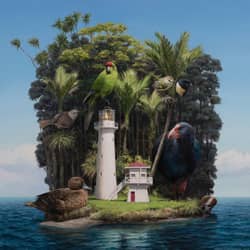
The Ark 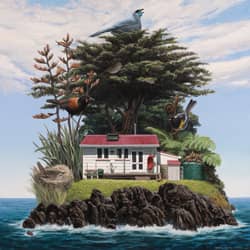
Ark 2 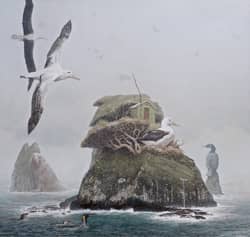
Castaway Depot 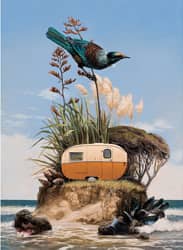
Freedom Camper 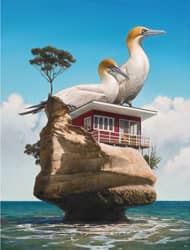
Gannet rock 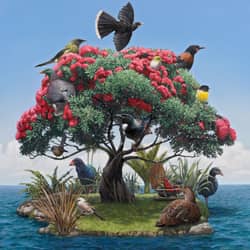
The Garden 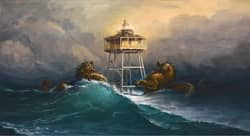
Unchartered 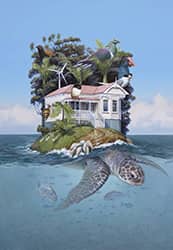
Sea shell 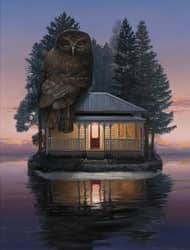
Nightsong 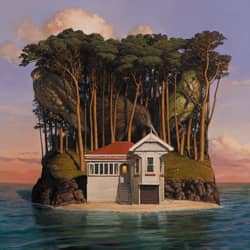
Wanderer's Nightsong